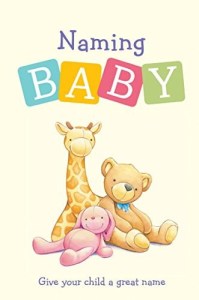
Naming Baby helps take the stress out of choosing the perfect name for your bundle of joy. It includes over 3000 boys’ and girls’ names, and their meanings, and provides lots of sound advice.
There is background information such as where to look for inspiration – old family names, friends, literature and history. And there are lists of:
There’s even a few simple pointers on how to avoid picking a bad name for your baby.
Naming Baby makes choosing your child’s name as easy as ABC. Good: Tidy condition.


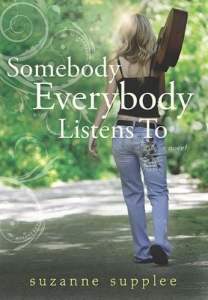
From the breakout author of Artichoke’s Heart, this bighearted novel is a must-read for anyone who has ever chased a dream (or hummed along with Taylor Swift).

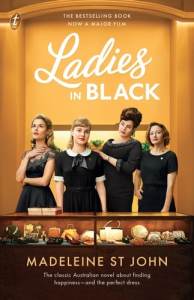
At the very end of the Ladies’ Frocks Departments, past Cocktail Frocks, there was something very special, something quite, quite wonderful; but it wasn’t for everybody: that was the point. Because there, at the very end, there was a lovely arch, on which was written in curly letters Model Gowns.
Written by a superb novelist of contemporary manners, Ladies in Black is a fairytale which illuminates the extraordinariness of ordinary lives. The women in black are run off their feet, what with the Christmas rush and the summer sales that follow. But it’s Sydney in the 1950s, and there’s still just enough time left on a hot and frantic day to dream and scheme…
By the time the last marked-down frock has been sold, most of the staff of the Ladies’ Cocktail section at F. G. Goode’s have been launched into slightly different careers. With the lightest touch and the most tender of comic instincts, Madeleine St John conjures a vanished summer of innocence. Ladies in Black is a g Now a major film. Very Good: Very tidy condition.

Mystery and adventure in Ancient Roman times for Flavia Gemina and her friends . . .
Sacred chickens, a jellyfish and a Roman mystery set in Britannia – this collection of mini-mysteries is the perfect recipe for a gripping read!
Includes an exclusive interview with Caroline Lawrence on the secrets of writing mystery stories!
Good: Tidy condition.


Engaging firmly in the debate, this book calls into question the dominance of evidence-based practice and sets out an alternative vision of care which places holism, professional judgment, intuition, and client choice at its center. Bringing together writers from a range of health and social care backgrounds, the book describes the rise of evidence-based practice and explores major criticisms of the approach. It argues that evidence should be seen as part of a broader vision of practice which places equal value on a holistic vision of the needs of patients and clients, professional knowledge and intuition, and seeing patients and clients as partners in their care. Case studies are used throughout the book to help readers link the concepts to practice.





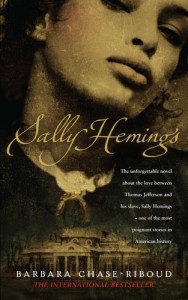
The story, told in alternating time narratives, begins in 1831 when Sally is aproximately sixty years old and is visited by a census taker called Nathan Langdon. With encouragement, Sally recounts her past to him. A past that begins when she passes into the ownership of her half-sister Martha Wyles who marries Thomas Jefferson. After Martha dies, Jefferson goes to Paris where he is joined by his two daughters. Elizabeth Hemings volunteers Sally as their maid, seeing it as Sally’s chance for freedom as slavery has been abolished in France. Jefferson and Sally fall in love and she returns to America with him, on the promises that they will go back to France someday and that she will be the only mistress of his estate in Monticello. Both promises are broken when Jefferson accepts political office and allows his daughter to live at Monticello after her marriage breaks down. Sally realises that nothing has or ever will change for her. A fact borne out when Jefferson dies and his will does not free her. Good: Tidy condition.


Edinburgh is a city whose history is written on its face. The Old Town on its crowded rock, sloping down from the Castle to Holyroodhouse, has not significantly changed its atmosphere since the turbulent fifteenth and sixteenth centuries, when riots, processions, or public executions jammed the High Street. And the very different era that followed the bloody religious wars of the seventeenth century is epitomized by the elegant streets and squares of the New Town – the eighteenth-century Enlightenment whose writers, philosophers and lawyers made Edinburgh famous.
This anthology of extracts from letters, memoirs, diaries, novels and biographies of interesting visitors and inhabitants, including the writings of Scott, Boswell, Cockburn, John Knox and many others, recreates for today’s visitors the drama, the history, and the life of the city in buildings and places that can still be visited. The daring Scottish recapture of the Castle from the English in 1313; the confrontation between Calvinist John Knox and Catholic Mary Queen of Scots in Holyroodhouse; an eye-witness account of the execution of Montrose at the Mercat Cross in 1650; reeking slop-pails in the wynds and polite manners in the ballrooms. . .