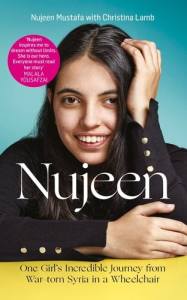
Read about Nujeen who escaped the hell of war in Aleppo and travelled to Europe in a wheelchair.
‘She is our hero. Everyone must read her story. She will inspire you’ MALALA YOUSAFZAI
Nujeen Mustafa has cerebral palsy and cannot walk. This did not stop her braving inconceivable odds to travel in her wheelchair from Syria in search of a new life. Sharing her full story for the first time, Nujeen recounts the details of her childhood and disability, as well as the specifics of her harrowing journey across the Mediterranean to Greece and finally to Germany to seek an education and the medical treatment she needs.
Nujeen’s story has already touched millions and in this book written with Christina Lamb, bestselling co-author of ‘I Am Malala’, she helps to put a human face on a global emergency.
Trapped in a fifth floor apartment in Aleppo and unable to go to school, she taught herself to speak English by watching US television. As civil war between Assad’s forces and ISIS militants broke out around them, Nujeen and her family fled first to her native Kobane, then Turkey before they joined thousands of displaced persons in a journey to Europe and asylum. She wanted to come to Europe, she said, to become an astronaut, to meet the Queen and to learn how to walk.
In her strong, positive voice, Nujeen tells the story of what it is really like to be a refugee, to have grown up in a dictatorship only for your life to be blighted by war; to have left a beloved homeland to become dependent on others. It is the story of our times told through the incredible bravery of one remarkable girl determined to keep smiling.
Good: Very tidy condition.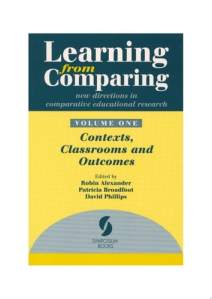
‘Learning from Comparing’ is a major two-volume study which reassesses the contribution of comparative educational research and theory to our understanding of contemporary educational problems and to our capacity to solve them. At a time when educational research is under attack on the grounds of ‘bias’ and ‘irrelevance’, and under pressure to address only those questions which are acceptable politically (as good a definition of bias as any), this is a serious attempt to bridge the worlds of research, policy and practice. The editors have put together a collection – in terms of both perspective and nationality – which ensures contrasting viewpoints on each topic.
Good: Tidy condition.





When Dave Harding holds his friend’s newborn baby, the biological clock he never knew existed starts ticking. Loudly. Which wouldn’t be so bad except his partner Izzy has no nine-month plans for fat ankles or trips to Baby Gap.
Then the music mag folds and Dave is temporarily forced to become Agony Uncle for ‘Teen Scene’. Knee deep in the adolescent outpourings of his readership, Dave opens one letter from a girl who doesn’t want advice about boys – she wants to know about Dave. Because she’s convinced that Dave Harding is her dad. And she’s got the facts to prove it.
Good: Very tidy condition.